




























• About
  • Advertise
  • Write For Us
  • Privacy Policy
  • Contact Us
Subscribe
Smart Investor Malaysia
Advertisement
  • Start Here
    • All
    • Guides
    • How-Tos
    • Analysis

    What You Need To Know About The Insurance Industry In Malaysia

    PropertyGuru: Malaysian Residential Property Market Continues To Face Challenges As Supply And Demand Declines

    Fed Turns The Tide In War On Inflation, But It’s Too Early To Declare Victory

    MRTT VS MRTA, What’s The Difference?

    The Smart Investor’s Guide to Insurance

    Highlights: Malaysia’s Revised Budget 2023

    4 Reasons Why You Need To Invest In ETF

    SPY vs SPUS: A 2023 Comparison of S&P 500 ETFs

    7 Tips For First-Time Home Buyers

    • Guides
    • How-Tos
    • Analysis
  • Investments
    • All
    • Asset Management
    • Stocks
    • Islamic Finance
    • Alternative Investments

    Investment Strategies for a Rosy Portfolio

    Evaluating Bitcoin as a Store of Value in 2024

    Uncovering Asset Gems: 2024 Morningstar Awards for Investing Excellence – Malaysia

    Invest Johor’s Vision Unveiled

    The Rise of The Ibu Boss

    Invest Johor’s Vision Unveiled

    Malaysia’s dance with FAANG Giants

    ICMR Research Series: Taking a Dual and Systematic Approach to Address Investor Vulnerability in Malaysia

    AIIMAN menjalin pakatan strategik dengan Bank Islam sebagai Rakan Pengedar Untuk Luaskan Capaian Kepada Produk Kekayaan Syariah

    • Asset Management
    • Stocks
    • Islamic Finance
    • Alternative Investments
  • Personal Finance
    • All
    • Cash Management
    • Grow Your Wealth
    • Protect Your Wealth
    • Distribute Your Wealth
    • Behavioural Finance

    Steering The Malaysia’s ESG Landscape

    Securing Your Legacy

    Personal Finance In The Cyber Age

    Protecting Your Welfare and Financial Interests in The Face of Mental Incapacity

    The Far-Reaching Impact of Inflation

    Trust In Transition: Ensuring Legacy Security Amidst Blended Family Dynamics

    ICMR Research Series: Taking a Dual and Systematic Approach to Address Investor Vulnerability in Malaysia

    Property Tussle: Being Left Homeless After Sister’s Death

    Employment Opportunity Fraud Syndicate: Lidt Cooperation Advertising Sdn Bhd Or Lidl Cooperation Advertising Sdn Bhd

    • Cash Management
    • Grow Your Wealth
    • Protect Your Wealth
    • Distribute Your Wealth
    • Behavioural Finance
  • Enterprise
    • All
    • Startups
    • Entrepreneurs
    • SMEs
    • Leadership
    • Business Planning
    • Fintech

    Invest Johor’s Vision Unveiled

    Ravi Vamathevan: Connecting Migrants, Changing Lives – The Valyou Sdn Bhd Story

    Exploring the Ethics of Artificial Intelligence and Machine Learning

    2023 Investor Day of icapital.biz Berhad (ICAP, 5108)

    From left Eizzar Supiar, AVP - Evaluation, Cradle_ Adlin Yusman, Co-Founder of BeMalas_ Suthenesh Sugumaran, Co-Founder of BeMalas_ and Joyce Wee, Former Executive Director of Etalage

    Cradle Circle: Bridging Visionary Startups and Investors in Second Series Event

    Gorgeous Geeks Marks 15 Years of Empowering Women in Technology

    MDDA Celebrates 30 Years of Industry Excellence

    DNA Mapping, A Revolutionary Medical Breakthrough

    Thomson Ushers In New Treatment for Spinal Muscular Atrophy

    • Startups
    • Entrepreneurs
    • SMEs
    • Leadership
    • Business Planning
    • Fintech
  • Property
    • All
    • First Time Home Buyers
    • Feature

    From Skyscrapers to Serenity: Malaysia’s Housing Harmony

    How Is The Malaysian Property Industry Doing Post-Covid?

    SIBS Secures Multi-Billion Ringgit Modular Apartment Building Project To NEOM, Saudi Arabia

    VIPs pour gold paint into the KL Wellness City logo, symbolizing the injection of life to the crown jewel of Malaysia’s medical tourism hub - KL Wellness City

    Official Launch Of KL Wellness City

    Pavilion REIT Concludes Acquisition Of Pavilion Bukit Jalil, Reinforcing Retail Portfolio

    PropertyGuru: Malaysian Residential Property Market Continues To Face Challenges As Supply And Demand Declines

    MRTT VS MRTA, What’s The Difference?

    6 Online Courses to Learn about ESG And ESG Investing

    7 Tips For First-Time Home Buyers

    • First Time Home Buyers
    • Central
    • Northern
    • Southern
    • Sabah & Sarawak
    • Regional / Global
    • Feature
  • ESG
  • News & Events
  • Bahasa Melayu
No Result
View All Result
  • Start Here
    • All
    • Guides
    • How-Tos
    • Analysis

    What You Need To Know About The Insurance Industry In Malaysia

    PropertyGuru: Malaysian Residential Property Market Continues To Face Challenges As Supply And Demand Declines

    Fed Turns The Tide In War On Inflation, But It’s Too Early To Declare Victory

    MRTT VS MRTA, What’s The Difference?

    The Smart Investor’s Guide to Insurance

    Highlights: Malaysia’s Revised Budget 2023

    4 Reasons Why You Need To Invest In ETF

    SPY vs SPUS: A 2023 Comparison of S&P 500 ETFs

    7 Tips For First-Time Home Buyers

    • Guides
    • How-Tos
    • Analysis
  • Investments
    • All
    • Asset Management
    • Stocks
    • Islamic Finance
    • Alternative Investments

    Investment Strategies for a Rosy Portfolio

    Evaluating Bitcoin as a Store of Value in 2024

    Uncovering Asset Gems: 2024 Morningstar Awards for Investing Excellence – Malaysia

    Invest Johor’s Vision Unveiled

    The Rise of The Ibu Boss

    Invest Johor’s Vision Unveiled

    Malaysia’s dance with FAANG Giants

    ICMR Research Series: Taking a Dual and Systematic Approach to Address Investor Vulnerability in Malaysia

    AIIMAN menjalin pakatan strategik dengan Bank Islam sebagai Rakan Pengedar Untuk Luaskan Capaian Kepada Produk Kekayaan Syariah

    • Asset Management
    • Stocks
    • Islamic Finance
    • Alternative Investments
  • Personal Finance
    • All
    • Cash Management
    • Grow Your Wealth
    • Protect Your Wealth
    • Distribute Your Wealth
    • Behavioural Finance

    Steering The Malaysia’s ESG Landscape

    Securing Your Legacy

    Personal Finance In The Cyber Age

    Protecting Your Welfare and Financial Interests in The Face of Mental Incapacity

    The Far-Reaching Impact of Inflation

    Trust In Transition: Ensuring Legacy Security Amidst Blended Family Dynamics

    ICMR Research Series: Taking a Dual and Systematic Approach to Address Investor Vulnerability in Malaysia

    Property Tussle: Being Left Homeless After Sister’s Death

    Employment Opportunity Fraud Syndicate: Lidt Cooperation Advertising Sdn Bhd Or Lidl Cooperation Advertising Sdn Bhd

    • Cash Management
    • Grow Your Wealth
    • Protect Your Wealth
    • Distribute Your Wealth
    • Behavioural Finance
  • Enterprise
    • All
    • Startups
    • Entrepreneurs
    • SMEs
    • Leadership
    • Business Planning
    • Fintech

    Invest Johor’s Vision Unveiled

    Ravi Vamathevan: Connecting Migrants, Changing Lives – The Valyou Sdn Bhd Story

    Exploring the Ethics of Artificial Intelligence and Machine Learning

    2023 Investor Day of icapital.biz Berhad (ICAP, 5108)

    From left Eizzar Supiar, AVP - Evaluation, Cradle_ Adlin Yusman, Co-Founder of BeMalas_ Suthenesh Sugumaran, Co-Founder of BeMalas_ and Joyce Wee, Former Executive Director of Etalage

    Cradle Circle: Bridging Visionary Startups and Investors in Second Series Event

    Gorgeous Geeks Marks 15 Years of Empowering Women in Technology

    MDDA Celebrates 30 Years of Industry Excellence

    DNA Mapping, A Revolutionary Medical Breakthrough

    Thomson Ushers In New Treatment for Spinal Muscular Atrophy

    • Startups
    • Entrepreneurs
    • SMEs
    • Leadership
    • Business Planning
    • Fintech
  • Property
    • All
    • First Time Home Buyers
    • Feature

    From Skyscrapers to Serenity: Malaysia’s Housing Harmony

    How Is The Malaysian Property Industry Doing Post-Covid?

    SIBS Secures Multi-Billion Ringgit Modular Apartment Building Project To NEOM, Saudi Arabia

    VIPs pour gold paint into the KL Wellness City logo, symbolizing the injection of life to the crown jewel of Malaysia’s medical tourism hub - KL Wellness City

    Official Launch Of KL Wellness City

    Pavilion REIT Concludes Acquisition Of Pavilion Bukit Jalil, Reinforcing Retail Portfolio

    PropertyGuru: Malaysian Residential Property Market Continues To Face Challenges As Supply And Demand Declines

    MRTT VS MRTA, What’s The Difference?

    6 Online Courses to Learn about ESG And ESG Investing

    7 Tips For First-Time Home Buyers

    • First Time Home Buyers
    • Central
    • Northern
    • Southern
    • Sabah & Sarawak
    • Regional / Global
    • Feature
  • ESG
  • News & Events
  • Bahasa Melayu
No Result
View All Result
Smart Investor Malaysia
No Result
View All Result
Advertise with Smart Investor Advertise with Smart Investor Advertise with Smart Investor
Home Start Here Analysis

What Net Zero Means for Inflation

4 years ago
0
71
SHARES
139
VIEWS
Share on FacebookShare on Twitter

Inflationary pressures are likely to increase amid measures to discourage high-carbon energy sources, although much depends on how policymakers intervene to tackle global warming.

Reducing carbon emissions is essential to curb global warming, one of the biggest long-term risks for the world economy. All countries across the globe will have to introduce ambitious mitigation policies over the next few years if the physical costs associated with a changing climate are to be limited.

Consensus among economists on carbon taxes as an effective policy lever to tackle climate change is rapidly growing.

By internalising the costs of the negative impact on health, the environment, and future generations, carbon taxes provide great incentives to transition to “net zero” emissions. They not only curb demand for fossil fuels, but also encourage business investment in renewable energy and low-carbon technologies, stimulating innovation.

In addition, they represent a source of government revenue. This can be used to finance tax reforms, lowering taxes on workers and businesses while supporting economic growth, or redirected to fund investment in climate technology.

Carbon taxes are fundamental to discourage the use of high-carbon energy sources and key to drive the behavioural change needed for the move towards net zero. They are, however, likely to have a large impact on energy and electricity prices, given the current widespread use of fossil fuels for energy production.

What Our Three Scenarios Tell Us

business man show increase market share, growth of profit investment

To analyse and better understand the impact of carbon taxes on inflation, we use the Oxford Economics Global Economic Model (GEM) to consider three different scenarios: Net Zero, Net Zero Transformation (NZT) and Delayed Transition.

Given the high degree of uncertainty around policy intervention to tackle global warming, scenario analysis is a key framework to assess the implications of climate-related risks.

In the Net Zero and NZT scenarios, global warming is limited to around 1.5°C by 2050 as carbon taxes start from 2022.

The Delayed Transition scenario, meanwhile, sees temperatures increase by 1.7°C as it assumes annual emissions do not decrease until 2030.

The key difference in assumptions between the first two scenarios is that only the NZT scenario assumes that there are wider economic benefits associated with innovation. NZT also factors in a greater amount of green investment from the private sector.

Carbon prices are lower than those in the Net Zero scenario as it is assumed that benefits from research and development bring down the marginal cost of reducing emissions.

The assumptions on carbon taxes for the different scenarios are shown in chart 1. These trajectories are consistent with the analysis done by the Network for Greening the Financial System (NGFS) that derives the carbon tax for a given degree of mitigation while maximising welfare. The Delayed Transition scenario highlights the risks associated with governments failing to act swiftly. The world ends up with more stringent policies from 2040 as a stronger price signal is needed to limit global warming. The chart also shows the economic benefits associated with greater innovation, reflected in much lower carbon taxes for the NZT scenario.

Chart 1
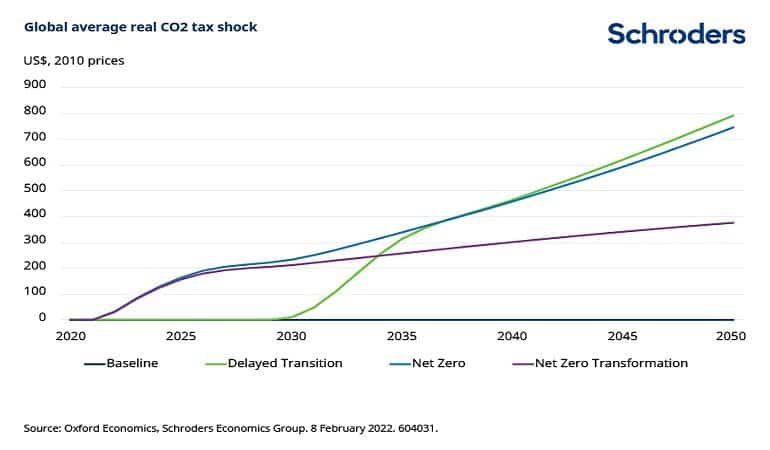
chart 1 inflation net zero schrodersCarbon prices rise to US$200 per tonne of carbon dioxide (tCO2) by 2030 and steadily increase to more than US$700/tCO2 in 2050 in the Net Zero scenario. Prices do not exceed US$400/tCO2 under NZT. In the Delayed Transition, carbon prices increase rapidly after 2030 to reach US$800/tCO2 in 2050.

Oxford Economics assumes that the government recycles 50% of the carbon tax revenues back to consumers in the Net Zero and in the Delayed Transition scenarios. The other 50% remains on government balance sheets and is partly used to fund investment.

In NZT, they assume that the government fully recycles revenues in the form of lump-sum transfers to households. Therefore, the clean energy transition is financed by increased government borrowing that takes the global economy on a higher equilibrium level of economic growth.

What Will Drive Inflation?

The impact on inflation will come via changes in energy prices. The Oxford Economics model assumes that fossil fuel supply is slow to adjust to the change in prices. In contrast, demand is more elastic, adapting more rapidly to a change in price. These are realistic assumptions.

Therefore, spot prices fall below baseline on the back of weaker demand for fossil fuels. However, the move in the spot price is not large enough to keep the after-tax price at the pre-shock level. Given the large magnitude of the tax increase, after-tax prices are significantly higher than their baseline level.

It is evident that oil prices will rise more rapidly in the Delayed Transition scenario starting from 2030 given the disorderly impact of the late policy implementation. Meanwhile, oil price increases are more modest in NZT thanks to the lower tax profile associated with greater innovation and green investment that boosts productivity.

Higher Inflationary Pressures On The Horizon

The recent developments in the gas and oil markets are already showing us how important energy prices are for headline inflation. Accelerating energy prices have been a key factor behind the recent surge in global inflation. Therefore, it should not come as a surprise that with the adoption of carbon taxes, inflationary pressures will increase globally. In addition, the move to net zero will also dramatically boost demand for key industrial metals used to generate and store renewable energy. Given the supply challenges, this is likely to add further pressure on inflation, via higher prices for aluminium, copper, cobalt and lithium.

Carbon prices are estimated to boost US headline CPI, adding 300 basis points (bps) to our baseline forecast in the years following the implementation of the carbon tax. However, higher inflation will be temporary as pressures on prices will be mostly concentrated in the early stages of the transition.

As countries decarbonise their energy production and move away from taxed products, inflation will start declining in the second half of 2020s, returning to its baseline level by 2050. Inflation under the NZT will return more quickly to its baseline due to higher productivity and less severe carbon pricing. Meanwhile, in Delayed Transition, inflation will start rising from 2030 and remain above the baseline in the longer term due to continued increases in taxation policy.

It is important to note that the impact on price growth will not be homogeneous across countries, as shown in chart 2. Over the next 30 years Brazil and France will see the smallest inflation increases, while Russia and South Africa are likely to experience the largest rises. The UK and Germany will also be affected, with the Net Zero transition expected to add more than 50bps to headline inflation over the next 30 years. The analysis also highlights the greater risks to price pressures associated with the delayed transition on the back of more severe increases in carbon prices.

Chart 2
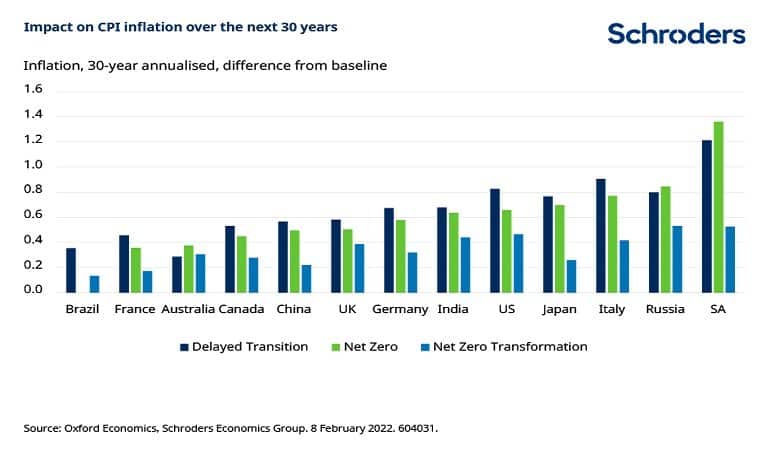
chart 2 inflation net zero schroders

The impact of carbon pricing across the globe will depend on various country-specific factors. First of all, the magnitude of carbon taxes is a key determinant in the change in energy prices. Most developed markets will see carbon prices well above the global average. Europe will experience the highest price, almost US$900/tCO2 in 2050 in the Net Zero scenario, closely followed by the US and Japan. European prices are higher than other developed countries due to the region’s relatively smaller endowment for CO2 removal, via carbon capture storage technology, for example. Carbon prices for emerging markets will be much lower than their developed counterparts, increasing to US$600/tCO2 by 2050.

Another key factor behind the cross-country differences of the inflationary impact is the energy mix. Countries that are currently more reliant on fossil fuels for their energy generation will be more exposed to carbon taxes, as a higher share of fossil fuels strengthens the pass-through to prices.

The degree to which energy prices rise also strictly depends on the carbon content of the fossil fuels used. This is because coal is much more carbon intensive than oil and especially gas, implying that for the same amount of tax, coal prices will rise more than the other fossil fuels.

It is therefore important not only to look at the amount of fossil fuels used in the energy production, but also at the carbon content of each source. Chart 3 highlights that emerging markets heavily rely on dirtier sources of energy. South Africa leads the way, as coal accounts for more than 60% of its energy demand, followed by China and India. Countries highly dependent on oil like Brazil, Japan, Russia and the US will also see significant increases in fuel prices.

Chart 3
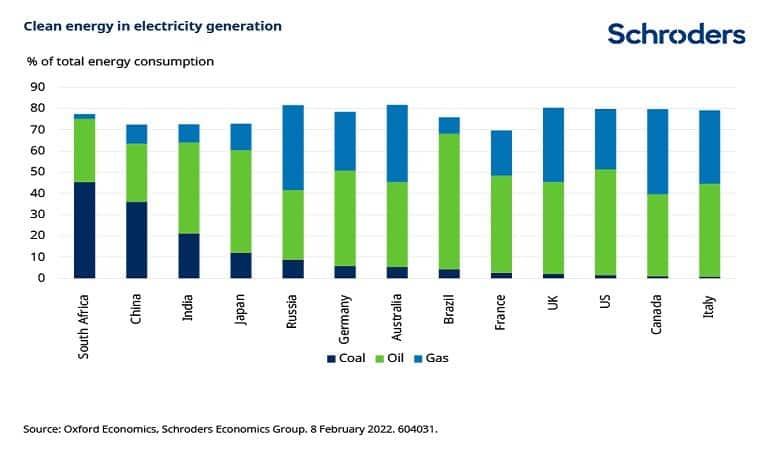
chart 3 inflation net zero schroders

Electricity prices will also be impacted by carbon taxes. The higher the share of renewables and nuclear used for electricity generation, the weaker the pass-through to electricity prices. Countries like France, Brazil, and Canada, whose electricity is already being produced with more than 80% of clean energy, will see a more modest rise in inflation.

Achieving net zero emissions requires a radical decarbonisation of the energy mix. By 2050, all coal mining will need to end, stranding these assets. Moreover, the majority of oil reserves will also be unburned. This means that developed countries will need to be less dependent on these dirty sources of energy, and consume low-carbon sources, like natural gas, and rely more on nuclear and renewables. By 2050, oil is assumed to account for less than 10% of total energy consumed for most developed economies (chart 4).

Chart 4
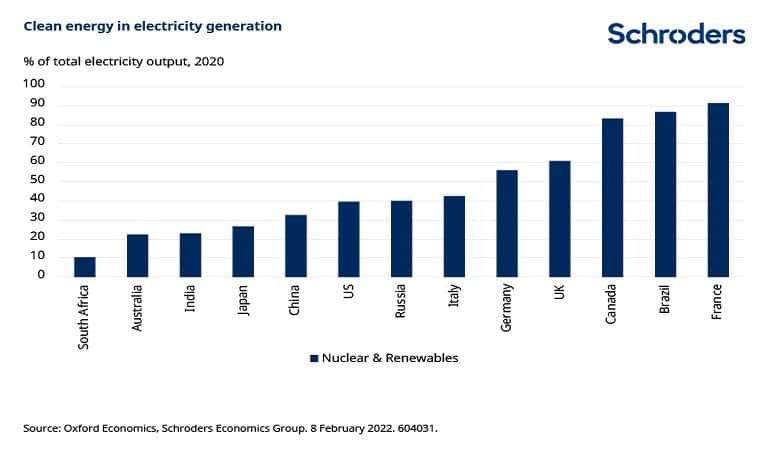
chart 4 inflation net zero schroders

What Are The Implications For Central Banks?

Carbon taxes represent an efficient policy tool to tackle environmental problems, but it is clear that they will lead to inflationary pressures. These will be felt across the globe, but will be more pronounced for economies that still largely rely on energy from fossil fuels. It is interesting that the impact on inflation in European countries will be more limited despite them likely to see the most severe carbon taxes and highest carbon prices. This is thanks to their greater use of clean energy, especially in France.

Our analysis also shows that inflationary pressures are mostly concentrated in the near term. The transitory nature of inflationary impact could imply that central banks look through the carbon pricing shock. The current prevailing consensus is that monetary policy should look through energy shocks as these tend to be short-lived and only result in a temporary deviation from the inflation target, provided that expectations remain anchored. And this is in line with what the Oxford Economics model assumes. But the energy transition will require a radical transformation in the energy sector, with the potential to generate large demand and supply imbalances, posing profound challenges to policymakers.

Finally, carbon prices are likely to act as a trigger for large investment stimulus, boosting employment and aggregate demand. Higher energy prices, if associated with a smaller output gap and stronger underlying price pressure, could force central banks to abandon any “look-through policy” and act to preserve price stability.

About the author

Irene Lauro is an economist at Schroders.

Tags: inflationnet zero
Previous Post

Changing Habits in a Cashless Society

Next Post

How to Protect Yourself at Different Stages in Life With Insurance

Next Post
life insurance

How to Protect Yourself at Different Stages in Life With Insurance

Leave a Reply Cancel reply

Your email address will not be published. Required fields are marked *

Morningstar Awards 2024 Morningstar Awards 2024 Morningstar Awards 2024
  • Trending
  • Comments
  • Latest

Robo Advisor In Malaysia, 8 Robo Advisor Platforms To Choose From

17/08/2022

MRTT VS MRTA, What’s The Difference?

11/10/2023
A calculator on financial chart, financial concept

Tax For The 6 Common Investments In Malaysia

19/09/2023
drawbacks unit trusts investment

5 Drawbacks Of Unit Trusts Investment That You Should Know Before Investing

19/09/2023

Digital Fundraising Platforms in Malaysia

Retirement Plans for the Self-Employed

SC Guidelines On Digital Assets

Retirement planning advise from the experts

Retirement Planning: Best Practices and Advice From Experts

inDrive Expands Financing with General Catalyst to US$300 Million to Fuel Growth and Innovation

19/03/2024

Investment Strategies for a Rosy Portfolio

19/03/2024

Evaluating Bitcoin as a Store of Value in 2024

19/03/2024

Tax Exemptions Breathe Life into Unit Trusts

14/03/2024

inDrive Expands Financing with General Catalyst to US$300 Million to Fuel Growth and Innovation

2 years ago

Investment Strategies for a Rosy Portfolio

2 years ago

Evaluating Bitcoin as a Store of Value in 2024

2 years ago

Tax Exemptions Breathe Life into Unit Trusts

2 years ago
Smart Investor Malaysia

© 2023 Smart Investor Malaysia | The contents on this website are for educational purposes only. You should always seek your own professional advice from the appropriate financial advisor or institution.

Category

  • About
  • Subscribe
  • Write For Us
  • Payment Policy
  • Shipping Policy
  • Cancellation and Refund Policy
  • Privacy Policy
  • Contact Us

Sign up to read our newsletter

  • Start Here
  • Investments
  • Personal Finance
  • Enterprise
  • Property
  • ESG
  • News & Events
  • Bahasa Melayu

© 2023 Smart Investor Malaysia | The contents on this website are for educational purposes only. You should always seek your own professional advice from the appropriate financial advisor or institution.

No Result
View All Result
  • Start Here
    • Guides
    • How-Tos
    • Analysis
  • Investments
    • Asset Management
    • Stocks
    • Islamic Finance
    • Alternative Investments
  • Personal Finance
    • Cash Management
    • Grow Your Wealth
    • Protect Your Wealth
    • Distribute Your Wealth
    • Behavioural Finance
  • Enterprise
    • Startups
    • Entrepreneurs
    • SMEs
    • Leadership
    • Business Planning
    • Fintech
  • Property
    • First Time Home Buyers
    • Central
    • Northern
    • Southern
    • Sabah & Sarawak
    • Regional / Global
    • Feature
  • ESG
  • News & Events
  • Bahasa Melayu

© 2023 Smart Investor Malaysia | The contents on this website are for educational purposes only. You should always seek your own professional advice from the appropriate financial advisor or institution.